Pioneering the Frontiers of Ambient Spatial Intelligence.
Twixels’ continuous research and development roadmap across generative radiance fields, on-device neural quantization, and zero-latency spatial foundation models.
Spatial Engine Chronology
Horizon 1: Real-Time Neural Splatting & Universal WebAR
Adaptive decimation pipelines for constrained WebAssembly and WebGL2/WebGPU mobile runtimes, reducing point density dynamically without visual fidelity degradation.
Motion-to-photon latency optimized for mobile Safari and Android Chrome, incorporating predictive pose interpolation to eliminate micro-jitter in unassisted AR scenarios.
Autonomous runtime fallback architecture ensuring 6-DOF persistent anchors across both native headsets and ambient mobile optical browser sessions.
Horizon 2: Generative 4D Spatial Foundation Models
4D Space-Time Reconstruction from Monocular Streams
Real-time dynamic deformation and physics-aware generation converting uncalibrated phone camera feed directly into interactive volumetric geometry.
Semantic Physical Occlusion
Deep multi-agent spatial understanding parsing architectural elements (floors, furniture boundaries, glass barriers) for collision-accurate virtual physics.
Dynamic Ambient Lighting Extraction
Extracts spherical harmonics and omnidirectional HDR lighting arrays on the fly to render virtual objects with optical fidelity identical to real room luminaires.
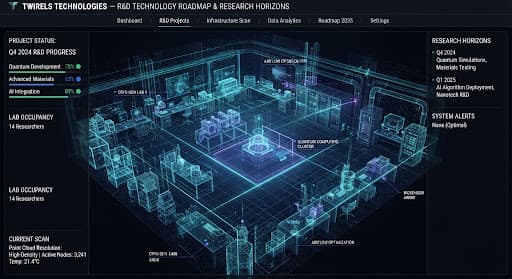
Horizon 3: Hardware-Agnostic Neural Co-Processor
Sub-Watt INT4 / FP8 Edge Quantization
Bespoke numerical quantization compilers tailored specifically to execute across Apple Silicon Neural Engine cores, Qualcomm Snapdragon XR2 Gen 2 architectures, and low-power Android WebGPU compute pipelines.
Zero-Throttling Thermal Equilibrium
Dynamic workload sharding that shifts tensor weights between spatial ray-tracing shaders and on-chip vector units to maintain room-temperature silicon profiles during continuous multi-hour augmented runtime.
Horizon 4: Ambient Spatial Operating Layer
Decentralized Spatial Coordinate Consensus
Peer-to-peer WebRTC mesh syncing persistent digital coordinates between nearby devices without relying on high-latency cloud spatial anchors or privacy-compromising centralized spatial cameras.
Autonomous Digital Twin Sensor Sync
Direct MQTT/telemetry ingestion transforming industrial smart sensors, robotic arms, and environmental monitors into live volumetric state overlays floating in absolute room space.
Proprietary Inventions & Publications
Twixels Technologies maintains a rigorous intellectual property registry covering neural geometry decimation, real-time optic fusion, and hardware accelerators.
Method and Apparatus for Real-Time Neural Octree Decimation in Constrained Web Runtimes
Covers hierarchical bounding volume trees optimized for non-blocking GPU compute passes across browser-based volumetric rendering engines.
Low-Latency Gaussian Radiance Fields on Mobile WebGPU Architectures
Twixels Neural Vision Group. Details zero-copy memory buffers and custom rasterization passes for rendering 1.2M Gaussians at 60Hz on handheld mobile devices.
Sub-Millimeter Visual-Inertial SLAM Fusion via Edge Neural Quantization
Architectural mechanism marrying optical flow arrays with IMU accelerometer telemetry through 4-bit neural weights, yielding absolute geometric drift under 0.05% over 100 meters.
Join the Twixels Pioneer R&D Partner Program
We collaborate with forward-thinking labs, defense contractors, robotics integrators, and next-gen XR pioneers. Gain direct access to our unreleased kernels and dedicated research SDK engineers.
Participation under bilateral mutual non-disclosure agreements. Compliant with international spatial encryption norms.